Authorized Voice & Power in the Boardroom: Reimagining Governance to Fulfill Philanthropy’s Purpose
A Call to Action and Guide for Foundation Boards
Centering community voice in board leadership isn’t just good practice—it’s essential to fulfilling philanthropy’s purpose. This principle is the driving force behind Authorized Voice & Power in the Boardroom, a call to action and a guide for organizational transformation. It invites foundation boards to reimagine their role, not as protectors of institutional legacy, but as stewards of purpose in full partnership with community.
Communities possess the wisdom and proximity required to drive meaningful solutions. When foundations share power with community, governance becomes a catalyst for equity, trust, and lasting impact.
Grounded in the Purpose-Driven Board Leadership (PDBL) framework, the resource is organized into three parts:
- It defines what it means to share power with community.
- It offers a mindset and framework for boards to lead with purpose.
- It provides actionable steps to evolve board structure, culture, and composition to center community voice.
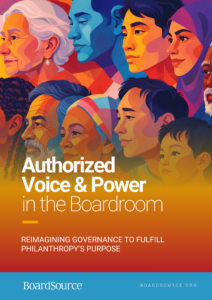

This transformation is not symbolic—it is structural. It calls on boards to examine how their composition, practices, and culture either reinforce or redistribute power. To support this reflection, the resource introduces tools like the Authorized Voice & Power Continuum, helping boards assess where they are and chart a path toward more inclusive governance that is accountable to community. It also illustrates what becomes possible when community members serve as co-creators and decision-makers in shaping philanthropic priorities, ensuring that strategy is grounded in lived experience and aligned with community-defined goals.
Despite the present-day challenges, this is a moment of possibility. By embracing community voice as a governing principle, foundations can empower the social sector to meet this moment with resilience and build a future where nonprofits realize their full potential. We invite foundation boards to use this resource as both a guide and a mirror, approaching change with humility, courage, and perseverance. Because when communities, nonprofits, and foundations share power together, philanthropy’s purpose is not only clarified—it is fulfilled.
PDBL is centered around four key principles:
Principle 1: Purpose before organization
Prioritizing the organization’s purpose, versus the organization itself. It reframes the duty of loyalty, focusing it on collective purpose and how the organization can best steward its resources in service to that purpose rather than centering only the organization itself.
Principle 2: Respect for ecosystem
An acknowledgment that the organization is part of a collection of organizations working to address societal challenges and impacts, recognizing that its actions can positively or negatively impact its surrounding ecosystem, and committing to being a respectful and responsible ecosystem player.
Principle 3: Equity mindset
A commitment to advancing equitable outcomes and interrogating and avoiding the ways in which the organization’s strategies and work (allocation of resources, board composition and culture, etc.) may reinforce systemic inequities
Principle 4: Authorized voice and power
The recognition that organizational power and voice must be authorized by those impacted by the organization’s work. This means engaging directly with those the organization seeks to serve in a way that ensures that decisions are made with a real understanding of community assets, needs, preferences, and aspirations.
Application of the PDBL framework during board deliberations and decision-making is a powerful tool in navigating uncertain times. It enables the board to effectively respond to the moment by keeping the organization’s purpose at the center.
Applying Authorized Voice and Power to Transform Foundation Boards
When applying the principle of Authorized Voice & Power, the Authorized Voice and Power Continuum offers a way for foundation boards to reflect on how voice and power are held, shared, or excluded in their governance structures and processes at any given moment. The continuum outlines common patterns so that boards are better able to assess where they are now and what work they need to do to get to full representation and inclusion of community voices on the board.
Authorized Voice and Power Continuum
| Board Approach | Role of Impacted Communities | How Power Is Held | Reflection Questions to Move Toward Greater AVP | |
| Informational | Community is not present; staff or intermediaries describe community needs. | Board relies on staff summaries or grantee reporting. | Who defines the needs we aim to address? Are we equipped to understand the impact of our work? | |
| Input-Based | Community provides input on pre-set topics. | Board gathers feedback (e.g., surveys, forums) to inform decisions. | What do we do with the input we are receiving? How could we invite input earlier and more consistently in our process? | |
| Advisory | Community representatives offer ideas but hold no decision-making power. | Advisory groups, councils, or panels exist but are structurally separate. | How could the advisory board and governing board work together more regularly and effectively? | |
| Influential | Community leaders shape strategy or funding priorities. | Board makes space for co-creation or participatory processes. | Who gets to frame the issue? Who helps design the solution? | |
| Shared Governance | Leaders with lived experience hold formal decision-making roles. | Community members serve as full board members or share governing authority. | How does our board reflect the people our work impacts? Who has a vote and voice? How does our governance function as a mechanism for foundation accountability to the community? | |
| Community-Led Governance | Community members lead and govern as the majority. | Community members hold the majority of voting power. | How is majority decision-making authority structured and exercised by community members on the board? In what ways do board leadership roles reinforce or dilute community authority? How are community priorities surfaced, debated, and translated into final board decisions? How does this governance model create accountability to the broader community beyond those seated at the table? |

How Foundation Boards can Transform Philanthropy
What would it look like for the community to co-create funding strategies as equal partners and decision-makers? What if the community was meaningfully and authentically centered in the design and execution of social change work, from vision to impact?
We are living through a time of profound change and philanthropy has a rare opportunity—not just to respond, but to transform. By embracing community voice, in principle and in practice, foundation boards can turn this moment of reckoning into one of renewal. Because when foundations, nonprofits, and communities exercise power together, the path to collective progress expands beyond measure.
We hope this call to action will inspire your board to embark on a purpose-driven journey. There is no perfect board and challenges and missteps are part of the journey. Yet, we invite you to approach this work with intention, curiosity, humility, and a commitment to the pursuit of purpose.
If you’re willing to share your thoughts with us, we’d love to hear from you. Your feedback helps us improve and your story could inspire others on their journey.
Special thanks to Fund for Shared Insight for their partnership in developing this resource.
101 Resource | Last updated: February 24, 2026